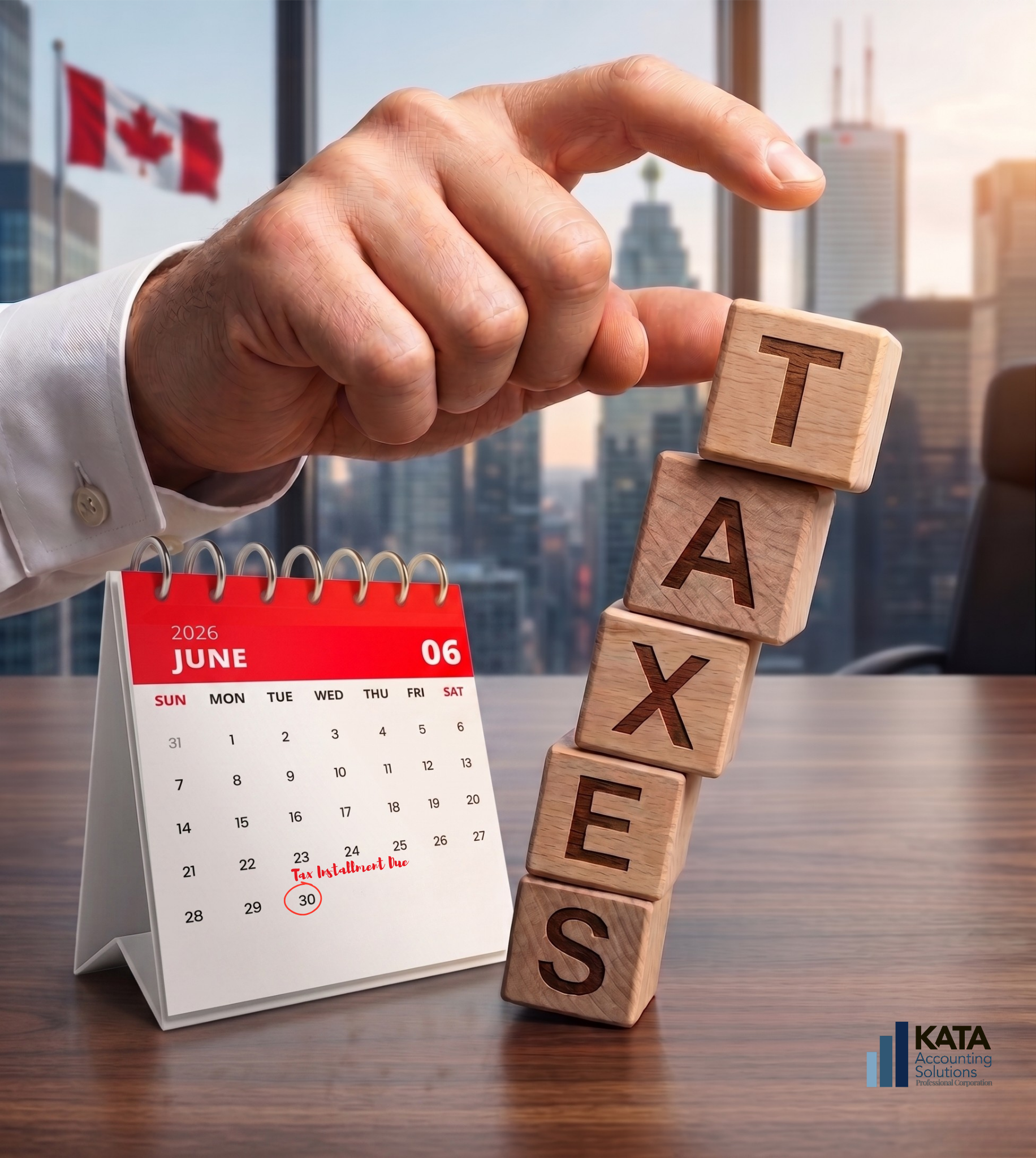
A Guide to Corporate Tax Installments
If there is one thing business owners love less than paying taxes, it’s paying more than they need to. Paying them early through corporate tax installments helps insure that no installment interest is levied, and no “bonus” taxes need to be paid.
At KATA Accounting, we often see the same look of confusion (and slight annoyance) when we tell a successful incorporation that they need to start sending money to the Canada Revenue Agency (CRA) every month or quarter. It feels like a cash flow drain, and if you aren’t prepared for it, it can feel like the government is double-dipping into your hard-earned revenue.
However, once your corporation hits a certain level of profitability, tax installments aren’t optional—they are a legal requirement. The good news? If you manage them correctly, installments actually prevent those massive, heart-attack-inducing tax bills at the end of the year.
Let’s break down everything you need to know about corporate tax installments so you can stay compliant and keep your cash flow predictable.
Who Actually Needs to Pay Installments?
In the early days of a corporation, you usually file your return, see what you owe, and pay it all at once. But the CRA doesn’t want to wait 15 months to get their hands on your money once you’re consistently profitable.
The Threshold:
You are required to pay corporate tax installments if your total taxes payable (the combined amount of Part I, Part VI, Part VI.1, and Part XIII.1 taxes) for either the current year or the previous year is more than $3,000.
When Are They Due?
The timing of your payments depends on the size and type of your corporation.
If you are a brand-new corporation in your first year of operation, you generally don’t have to pay installments because you don’t have a “prior year” tax base. But the moment you cross that $3,000 threshold, you should expect a letter from the CRA (or a nudge from us) letting you know that you’ve entered the world of installments.
1. Monthly Installments
Most corporations are required to pay monthly. These payments are due on the last day of every month of your fiscal year.
2. Quarterly Installments
There is a “small business” exception. You may be eligible to pay every three months instead of every month if you meet all of the following criteria:
- You are a Canadian-controlled private corporation (CCPC).
- You have a perfect compliance record (no late filings or unpaid remittances) over the last 12 months.
- Your “taxable income” for the current or previous year is $500,000 or less.
- Your “taxable capital” employed in Canada is $10 million or less.
For quarterly payers, your installments are due on the last day of each quarter of your fiscal year.
How the CRA Calculates Your Installments
This is where people often get tripped up. The CRA doesn’t actually know exactly how much you’re going to make this year, so they use three different methods to calculate what you “should” be paying. You are allowed to choose the method that results in the lowest payment.
Method 1: The Current Year Estimate
You estimate what your tax will be for the current year and divide it by 12 (monthly) or 4 (quarterly).
- Risk: If you underestimate and don’t pay enough, the CRA will charge you interest.
Method 2: The Prior Year Base
You base your payments entirely on what you owed last year.
- Benefit: If your income is skyrocketing this year, this method lets you “defer” the tax on that extra growth until your final filing deadline without penalty.
Method 3: The Combined (Pre-Prior Year) Method
This is the CRA’s default for monthly payers.
- Your first two installments are based on the tax from two years ago.
- Your remaining ten installments are based on last year’s tax (minus what you already paid in the first two months).
- This exists because when you start a new fiscal year, you likely haven’t even finished the tax return for the year that just ended!
Common Mistakes: Where Business Owners Get Burned
Managing installments isn’t just about the math; it’s about the administration. Here are the pitfalls we see most often:
1. Ignoring the “Instalment Reminders”
The CRA sends out reminders, but they are often based on Method 3. If your business has seen a significant drop in income, following the CRA’s reminder might mean you’re overpaying and giving the government an interest-free loan. Conversely, ignoring them because “business is slow” without actually doing the math can lead to heavy interest charges if you’re wrong.
2. Mixing up the Balance Due Date and the Filing Date
This is a big one. For most CCPCs, your taxes are due 3 months after your fiscal year-end, even though your tax return isn’t due for 6 months. If you wait until you file your return to pay the remaining balance, you will be hit with 3 months of arrears interest.
3. Forgetting the “Large Corporation” Rules
If your taxable capital exceeds $10 million, the rules change, and the margin for error shrinks. Large corporations often have stricter installment requirements and higher penalties for underpayment.
Strategies to Manage Installments Smoothly
The goal of installment management is to keep as much cash in your business as possible while avoiding CRA interest. Here is how we recommend handling it:
- The “Tax Savings” Bucket: Get into the habit of transferring a percentage of every invoice or every month’s revenue into a separate high-interest savings account. When the end of the month rolls around, the money for the installment is already there, and you kept the interest it earned in the meantime.
- Quarterly Reviews: Don’t wait until year-end to talk to your accountant. A quick mid-year check-in allows us to look at your year-to-date profit and determine if your installment “estimate” needs to be adjusted. If business is booming, we can increase payments to avoid a massive bill later. If business is down, we can stop installments and save your cash flow. KATA’s subscribed bookkeeping clients receive these monthly.
- Pay via My Business Account: Avoid mailing checks. Using the CRA’s “My Business Account” portal allows you to see exactly what has been processed and ensures the payment is timestamped. Most major banks also now allow you to pay through online banking, which tends to be easier to navigate.
- The “Safe Harbor” Rule: If you pay based on the “Prior Year” (Method 2), and you pay those amounts on time, the CRA cannot charge you interest—even if you end up making $10 million more than expected. This is the safest way to manage a rapidly growing business.
The Bottom Line
Corporate tax installments feel like a burden, but they are actually a sign of a healthy, profitable business. By understanding which calculation method works best for your specific situation and setting up a system to automate the savings, you can turn a potential year-end nightmare into a minor monthly line item.
If you’re unsure which method you should be using, or if you’ve received an installment reminder and aren’t sure if the numbers are right, give us a shout. We’re here to make sure you keep as much of your money as possible while keeping the taxman off your back.