Claiming Vehicle Expenses
Updated March 2026
Vehicle expenses can really add up. With current inflation rates and fluctuating energy prices, it’s important to take the tax deductions you can. The use of a personal vehicle can be tax-deductible for both employees and self-employed individuals. Keep reading to learn the specifics and get the most tax deductions from your vehicle expenses in 2025.
Vehicle Expense Documentation Requirements
The Canada Revenue Agency (CRA) requires a mileage log. In 2025, the CRA increased its use of data-matching to verify vehicle claims. Almost any review that finds no mileage log will result in the disallowance of all vehicle expenses.
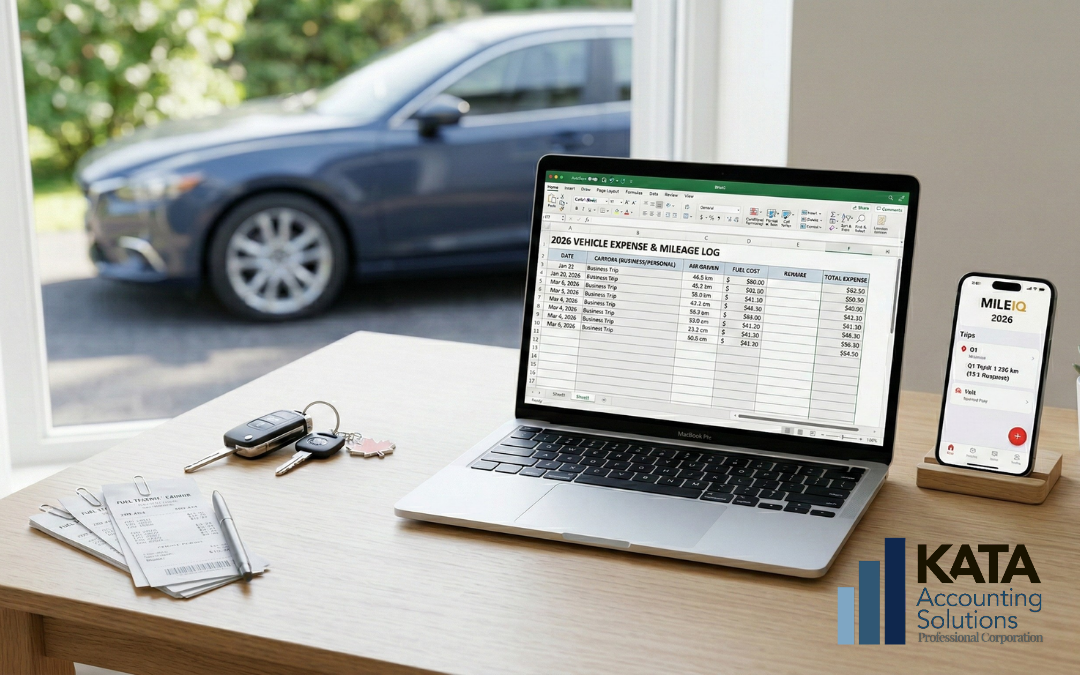
Mileage Log for Vehicle Expenses
A mileage log must include:
- Opening Odometer Reading: The reading on January 1, 2025.
- Ending Odometer Reading: The reading on December 31, 2025.
- Detailed Information for Each Trip: Date, destination, business purpose, and distance.
While writing on receipts is a start, the CRA now prefers digital logs with GPS verification.
Digitally timestamped logs are much harder to dispute during an audit.
How Vehicle Expense Tax Deductions Work
To calculate your deduction using the Actual Expense Method, add the total kilometres driven for business purposes and divide it by the total kilometres driven for the year. Multiply this percentage by your total operating costs (fuel, insurance, maintenance, etc.) to determine your final deduction.
Example: If you drove 20,000 km in 2025, and 10,000 km were for business, you can claim 50% of your total vehicle expenses. [10,000 km / 20,000 km = .5 or 50% ]
Shareholders & Employees
Shareholders and employees should maintain a meticulous mileage log. If you use a personal vehicle for business, the corporation can pay you a tax-free per-kilometre allowance.
T1 Personal Tax Returns
If you drive your personal vehicle for business purposes, you can claim expenses. Employees generally require a Form T2200 (Declaration of Conditions of Employment) signed by their employer.
Possible Vehicle Expense Deductions:
- Fuel (Gasoline, Propane, Oil) and Electricity (Charging for EVs)
- Maintenance and repairs
- Insurance
- Interest on car loans (Limited to $350/month in 2025)
- Licensing and registration
- Leasing costs (Limited to $1,100/month for leases entered in 2025)
- Capital Cost Allowance (CCA) (Depreciation)
To reflect the 2025 marketplace where electric and hybrid vehicles are common. Electricity and Charging Costs are now standard deductible expenses for ZEVs.
CRA Prescribed Mileage Rates
If you are a shareholder or employee charging back mileage to a corporation, use the latest rates:
$0.72 per km for the first 5,000 kms; $0.66 per km thereafter.
Note: If you live in the Northwest Territories, Yukon, or Nunavut, the rates are 4¢ higher (76¢ and 70¢ respectively).
Company Owned Vehicles & Standby Charges
The Operating Cost Benefit (taxable benefit for personal use of a company car) is $0.34 per km for 2025. If you are in the business of selling or leasing cars, the rate is $0.31 per km.
2025 Capital Cost Allowance (CCA) Limits
When purchasing a vehicle in 2025, be aware of the “Luxury Tax” ceilings:
- Class 10.1 (Passenger Vehicles): The ceiling is now $38,000 (before tax).
- Class 54 (Zero-Emission Vehicles): The ceiling remains $61,000 (before tax).
Looking Ahead to 2026
While you are filing for 2025 now, remember that the rates have shifted again for the current year (2026). The per-km rate has climbed to 73¢ and the CCA ceiling for new purchases in 2026 is now $39,000.
Additional Updates
1. The “Productivity Super Deduction” (ZEV Write-off)
In 2026, businesses can benefit from the Reaccelerated Investment Incentive. For Zero-Emission Vehicles (Class 54) acquired in 2026 and available for use before 2030, you can still claim a 100% first-year write-off (subject to the $61,000 cap). This is a massive cash-flow advantage for small businesses switching to electric fleets.
2. Capital Gains Inclusion Rate Changes
Effective June 25, 2024, the capital gains inclusion rate for corporations is 2/3 (increased from 1/2). For individuals, it is 2/3 for gains exceeding $250,000. The $250,000 threshold for individuals is annual and applies to net capital gains.
- While most passenger vehicles depreciate, certain luxury or “collector” business vehicles may sell for a gain. The tax hit on these gains is higher starting in 2026.
3. Digital Logbook Verification & AI Tools
The CRA has modernized its audit process. They now frequently request digital records over paper logs.
4. EV Charging Infrastructure Credit
Remind owners that they may also be able to claim the cost of installing EV charging stations at their place of business under Class 43.1 or 43.2, which also often qualifies for accelerated depreciation.
5. Remote Work & T2200 Requirements
With many employees still working in hybrid models in 2026, the T2200 is more important than ever. Clarify that travel from home to a “regular place of employment” is still not deductible, even if you only go in once a week.
Don’t let your hard-earned business miles go to waste or, worse, trigger a costly CRA review. In the evolving tax landscape of 2026, the difference between a significant deduction and a disallowed expense often comes down to a single, detailed mileage log. From avoiding the pitfalls of commuting claims to navigating the latest ZEV incentives, precision is your most valuable asset. You deserve a tax strategy that works as hard as you do. Are you confident that your vehicle expenses are optimized and fully compliant? Contact KATA Accounting today to review your records and secure the deductions you’ve earned. Let’s take the guesswork out of your taxes so you can focus on the road ahead.