Accountex 2026 Takeaways: The AI Revolution and the Return of Bare Trust Rules
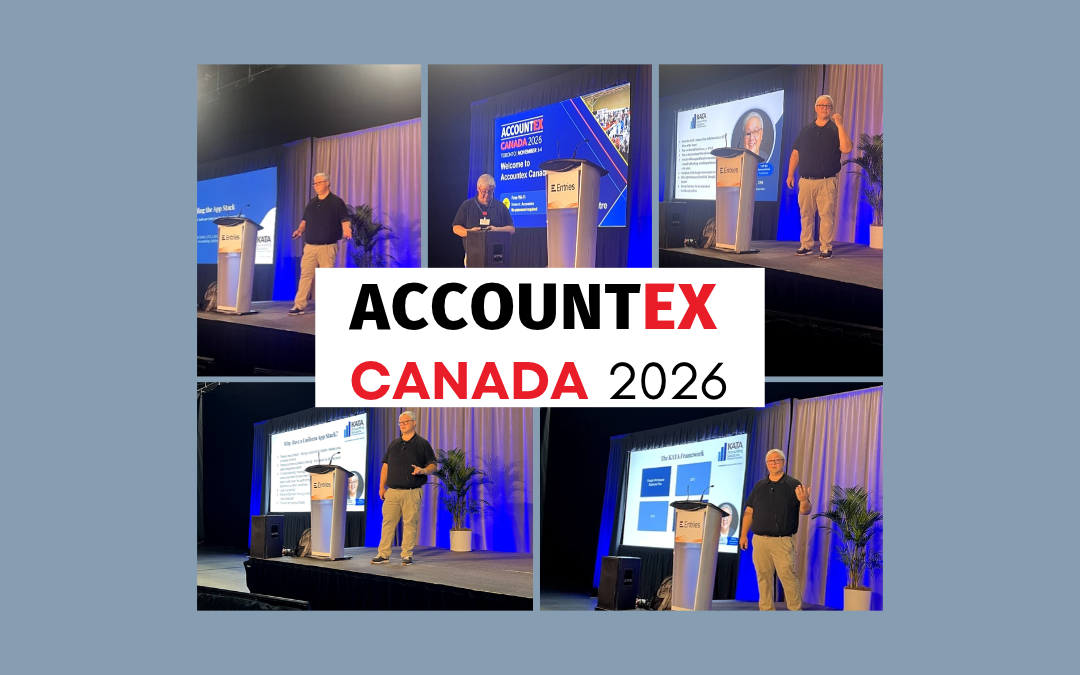
At KATA Accounting, if there is one thing we love more than balancing the books and optimizing your tax strategy, it is staying ahead of the curve. Recently, the accounting world gathered for Accountex 2026, the premier event where industry leaders, tech innovators, industry vendors and tax professionals converge to map out the future of our profession.
Coming out of the conference, the energy was palpable. The accounting landscape is undergoing a massive shift, driven by a fascinating intersection of cutting-edge technology and increasingly rigorous regulatory compliance. For business owners, entrepreneurs, and everyday taxpayers, these industry shifts translate directly into how we manage your finances, protect your wealth, and keep you on the right side of the Canada Revenue Agency (CRA).
From our perspective here at KATA Accounting, there were two undeniable main events at Accountex 2026: the rapid, practical implementation of Artificial Intelligence (AI) in accounting research and workflows, and the return of bare trust reporting requirements for the 2026 tax season.
Here is our deep dive into what you need to know about both, and how they will impact you and your business in the coming year.
AI is the New Standard
For years, “Artificial Intelligence” felt like a futuristic buzzword thrown around at tech conferences but rarely seen in practical, day-to-day accounting. Accountex 2026 proved that the future has officially arrived. Recent industry intelligence revealed at the event highlighted that AI adoption among Canadian accounting firms has now hit a staggering 43%. (Keep in mind that this figure is likely skewed higher as more traditional firms are more likely to not respond to these types of surveys.)
Firms that are failing to establish AI workflows risk falling behind in operational efficiency and client service. But what does this actually mean for you, the client? It means your accounting team is about to become faster, smarter, and much more focused on high-level advisory rather than manual data entry.
The key hang-up is going to be the availability of information. Leveraging AI tools is far more effective with clean, complete data sets. If information is incorrect or unavailable, AI tools won’t really help improve performance.
Here are the core operational areas where AI is completely changing the game:
1. Automated Data Reconciliation
Historically, reconciling accounts with multiple currencies or tracking down ledger anomalies meant hours of manual line-by-line checking. Today, machine learning algorithms can match complex, multi-currency transactions and reconcile bank statements in seconds rather than hours. For your business, this means faster month-end closes and real-time financial visibility.
2. Predictive Cash Flow Modeling
Cash flow is the lifeblood of any business. We are now seeing AI engines that analyze your historical spending patterns, seasonal dips, and revenue spikes to forecast working capital crunches with incredible precision. Instead of just telling you how your business performed last month, AI tools allow us to predict your liquidity reserves for the next quarter, helping you make proactive hiring or purchasing decisions.
3. Smart Tax Document Classification
Tax season usually involves a mountain of slips, receipts, and source documents. Through the pairing of Optical Character Recognition (OCR) and Natural Language Processing (NLP), AI can now automatically scan, read, and categorize complex tax documents instantly. This drastically reduces human error and speeds up the preparation of your personal and corporate returns. (Keep in mind that AI operates on probabilistic concepts, so if something doesn’t fit the pattern, AI will try to force it into the patterns it sees.)
4. Enhanced Advisory and Communication
AI copilots are now assisting practitioners in drafting complex tax scenario summaries and initial client correspondence. By automating the routine aspects of communication and initial research, our team at KATA Accounting can spend more time doing what a machine cannot do: understanding your unique life goals and relationships, listening to your business challenges, and crafting bespoke tax strategies.
Ultimately, AI is not replacing your accountant. It is removing the robotic tasks from our desks so we can be more human, more strategic, and more available to you.
How KATA is Adopting AI
Policy First
To ensure the privacy and safety of our client’s information, we have created an AI Use policy for our internal team, and an AI Transparency policy for our clients and prospects. Some of the key highlights include:
- Yes, we use AI that is proven and paid. Remember, if the product is free, you are the product. If you work with KATA, your data is likely touched by AI at some point. (Note that the many major companies are rolling out AI without being transparent, so a large set of your data is likely already exposed to AI tools.)
- We ensure that no client information is used to train third-party Large Language Models (LLMS) such as Chat GPT or Claude.
- Our team is ONLY allowed to use approved AI tools. If a new tool is considered, it gets vetted by our team and for our standards before being implemented.
- We take the old adage, “Trust, but verify.” This means we test the AI tools we use extensively and a human reviews and approves all work completed by an AI before anything goes to the client. AI cannot replace a qualified professional.
- We strive to be environmentally responsible in our use of AI. Therefore, we rarely create video and audio content using AI, and try to avoid using it to create images.
- We are transparent about how we leverage technology and use your data.
- Internally, we regularly share what we’re learning about AI and how to use it. We also have regular teaching moments where we reinforce our technology and remote work policies including our AI policies.
- KATA Accounting is ultimately responsible for the outputs provided to clients.
Getting Organized
KATA has developed the KATA Pulse by SmartSystems©, a dashboard that allows our team to see what they need to do in one place.
For instance, a teammate can see which files they are responsible for, what information we’re waiting on, or which teammate has an outstanding action. It also shows us when the file was last updated so we can push things along. It also helps track the time we’re spending on files without the need for a time tracking app. We hope that within the year, this will become our comprehensive practice management and CRM tool.
Customer Service & Sales
We’re pleased to have launched the KATA Concierge last year. Using this tool, prospective clients can learn more about KATA Accounting and what we do. It can help them book a one-off consultation taking them right through the payment platform and booking process.
Our regular clients can enter their name and secret code and find out specific information about the state of their tax return, project or monthly bookkeeping. We’ve ensured that it has guardrails and won’t provide personal information you should already have, such as your SIN number. We also allow it to say it doesn’t know something – we’d rather it say it doesn’t know rather than give an incorrect answer.
We’re still in broad testing of this tool, so if you use it, we’d appreciate any feedback. Our goal is to allow for our tax clients to be interviewed by KATA Concierge instead of completing a questionnaire (though we can always send the questionnaire.)
Research
We also have an internal tool called KATA Companion that lives on KATA Pulse. Essentially, this functions like a research assistant allowing the team to look up rules, Income Tax Act provisions and so on very, very quickly.
Strong guardrails have been built into this tool. If a teammate asks it a question about something that KATA would not work on, it tells them so. For instance, though we have helped with Canadian tax, accounting and bookkeeping issues in 32 different countries, we don’t do any non-Canadian tax work, so asking a question about a US tax issue would trigger the guardrails.
Agent Smith is Coming
OK, well, not “Agent Smith.” We don’t want to tempt fate, Neo…
We are developing agents that can do simple tasks such as move projects along at all hours, gather and rename data submitted by clients, organize information for our team, and so on. As we go deeper on this venture, we recognize that agents will start doing the tasks that junior bookkeepers and accountants used to do. This creates a skills and talent development conundrum – How do we develop the next generation of talent if the junior jobs are gone?
People are the Heart
We’ve made a commitment to our team and our external partners that as people are willing to learn, grow and develop, we will keep them employed.
We recognize that junior talent still needs to be hired and brought along. However, the learning curve is even steeper than it used to be. Our goal is for any junior talent to be brought to the intermediate level within 3 months of starting at KATA. This means learning how to do things “the old way” so they can understand how to fix things if AI does it wrong. This also means developing more critical thinking and professional skepticism skills quicker.
Our goal is for our existing team to be the seniors and intermediates, with the AI Agents being the juniors. This will allow them to have better relationships with our clients – and that’s what we want, relationships, not transactions.
The Return of the Bare Trust Rules for 2026
While AI was the star of the technology discussions, the most pressing compliance topic at Accountex 2026 was the finalization of the bare trust reporting rules.
If you recall, the federal government previously expanded trust reporting rules to improve transparency around beneficial ownership. However, after widespread administrative confusion, the CRA provided last-minute relief, waiving the filing requirements for the 2023, 2024, and 2025 taxation years. For the 2023 tax season in early 2024, that relief was issued the day before the deadline, so many bare trust returns had already been filed.
That relief has officially expired.
With the passage of Bill C-15, which received Royal Assent on March 26, 2026, the CRA has confirmed that bare trust reporting is back and mandatory for the 2026 taxation year. The first real T3 filings under these new rules will be due on March 31, 2027, for trusts with a December 31 year-end.
What is a Bare Trust?
A bare trust is a legal arrangement where one person or entity (the legal owner) holds title to a property or asset on behalf of someone else (the beneficial owner), but the legal owner has no independent power, discretion, or responsibility over the asset. They act solely on the instructions of the beneficial owner.
Because these arrangements do not require formal legal trust documents, many taxpayers are entirely unaware that they are part of a bare trust. Common examples include:
- Real Estate Financing: A parent adding their name to an adult child’s property title solely to help them qualify for a mortgage, without retaining any beneficial ownership.
- Convenience Accounts: Adding an adult child to an aging parent’s bank account or non-registered investment account to help manage finances or avoid probate.
- In-Trust-For (ITF) Accounts: A parent or grandparent opening an investment account “in trust for” a child or grandchild.
- Corporate Nominees: A nominee corporation holding legal title to real estate on behalf of an individual, joint venture, or operating business.
If you fall into any of these categories, you may be considered a trustee of a bare trust and be required to file a T3 Trust Income Tax and Information Return, as well as Schedule 15 (Beneficial Ownership Information of a Trust).
Important Exemptions Under the Revised Rules
The good news from the finalized legislation is that the government listened to the feedback from the accounting community. Bill C-15 introduced several important exemptions that will carve out many everyday, low-risk arrangements.
If your arrangement meets any of the following criteria, you are generally exempt from filing for 2026:
- The $50,000 Threshold: Trusts holding assets with a total fair market value of $50,000 or less throughout the entire year are exempt. There is no restriction on the type of assets held.
- The $250,000 Family Trust Exemption: Trusts holding eligible assets with a total fair market value that does not exceed $250,000 throughout the year are exempt, provided all trustees and beneficiaries are individuals related to each other. Note that the list of assets that can allow for this exemption are specific, and surprisingly, limited partnership units (reported on a T5013) are not on the list at the time this was written.
- The Three-Month Rule: Trusts that have been in existence for less than three months at the end of the year are exempt.
- Principal Residences: Certain arrangements involving mirror-ownership between related parties on a principal residence are excluded.
- Note: There are other exemptions that we did not list here to keep this article readable.
Penalties for Non-Compliance
The CRA is taking this transparency initiative very seriously. If your arrangement is not exempt, failing to file the required T3 return and Schedule 15 can result in a standard penalty of $25 per day, up to a maximum of $2,500 issued to the Trustee.
However, if the CRA determines that the failure to file was done knowingly or due to gross negligence, the penalties escalate drastically to the greater of $2,500 or 5% of the highest total fair market value of the trust’s property during the year. For a $600,000 family cottage held in a bare trust, a 5% penalty equates to $30,000 per year!
What You Should Do Now
While the filing deadline of March 31, 2027, might feel far away, the preparation needs to start now. Identifying these structures and gathering the required personal information (names, addresses, dates of birth, and SINs) for every trustee, beneficiary, and controlling person takes time.
Here is your action plan for the remainder of the year:
- Review your arrangements: Look at all property titles, bank accounts, and investment accounts. If your name is on an asset that truly belongs to someone else, or someone else’s name is on an asset that belongs to you, flag it.
- Test against the exemptions: Check if your arrangement falls under the $50,000 or $250,000 thresholds.
- Reach out to us: Determining if an exemption applies is not always straightforward, and the risk of getting it wrong is high.
At KATA Accounting, we are proactively reviewing our clients’ profiles to identify any reportable bare trusts. By leveraging the latest technological tools—yes, including those AI integrations we discussed above—we are ensuring that our clients remain compliant without the administrative headache.
The accounting industry is changing, but our commitment to your financial success remains the same. If you have any questions about how AI is improving our service, or if you suspect you might be part of a bare trust arrangement, do not hesitate to reach out to our team.